Authored Monographs & Edited Volumes

Global Geopolitics, Heritage Diplomacy & Transnational Cultural Flows

Geopolitics of Digital Heritage

Grincheva, N. and Stainforth, E. (2024). Geopolitics of Digital Heritage. Cambridge: Cambridge University Press.
ISBN 9781009182089, https://doi.org/10.1017/9781009182072


Geopolitics of Digital Heritage analyzes and discusses the political implications of the largest digital heritage aggregators across different scales of governance, from the city-state governed Singapore Memory Project, to a national aggregator like Australia's Trove, to supranational digital heritage platforms, such as Europeana, to the global heritage aggregator, Google Arts & Culture.

These four dedicated case studies provide focused, exploratory sites for critical investigation of digital heritage aggregators from the perspective of their geopolitical motivations and interests, the economic and cultural agendas of involved stakeholders, as well as their foreign policy strategies and objectives.

The Element employs an interdisciplinary approach and combines critical heritage studies with the study of digital politics and communications. Drawing from empirical case study analysis, it investigates how political imperatives manifest in the development of digital heritage platforms to serve different actors in a highly saturated global information space, ranging from national governments to transnational corporations.


To learn more, listen to book interviews conducted by Dave O'Brien on New Books Network and Samira Farah on Triple R Radio.

Museum Diplomacy in the Digital Age

Grincheva, N. (2020). Museum Diplomacy in the Digital Age. Routledge.
ISBN 9780815369998, https://doi.org/10.4324/9781351251006


Museum Diplomacy in the Digital Age explores online museums as sites of contemporary cultural diplomacy.

Building on scholarship that highlights how museums can constitute and regulate citizens, construct national communities, and project messages across borders, the book explores the political powers of museums in their online spaces. Demonstrating that digital media allow museums to reach far beyond their physical locations, Grincheva investigates whether online audiences are given the tools to co-curate museums and their collections to establish new pathways for international cultural relations, exchange and, potentially, diplomacy. Evaluating the online capacities of museums to exert cultural impacts, the book illuminates how online museum narratives shape audience perceptions and redefine their cultural attitudes and identities.

Museum Diplomacy in the Digital Age will be of interest to academics and students teaching or taking courses on museums and heritage, communication and media, cultural studies, cultural diplomacy, international relations and digital humanities. It will also be useful to practitioners around the world who want to learn more about the effect digital museum experiences have on international audiences.

Global Trends in Museum Diplomacy
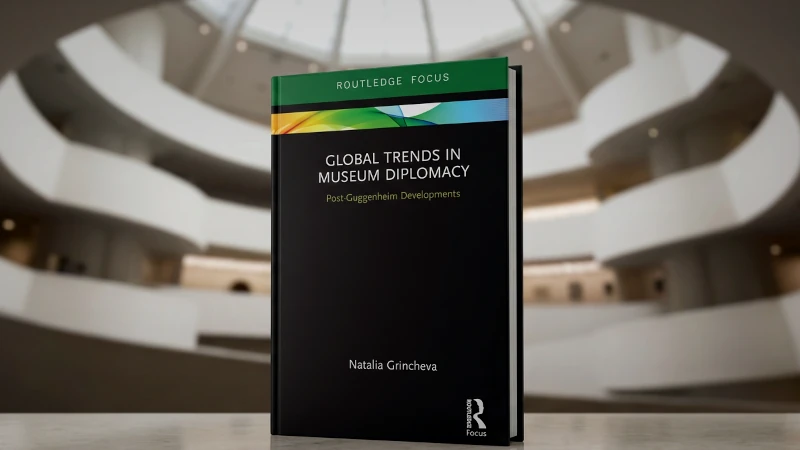
Global Trends in Museum Diplomacy

Grincheva, N. (2019). Global Trends in Museum Diplomacy: Post-Guggenheim Developments. Routledge.
ISBN 9780367787943, https://doi.org/10.4324/9781351190275


Global Trends in Museum Diplomacy traces the transformation of museums from publicly or privately funded heritage institutions into active players in the economic sector of culture. Exploring how this transformation reconfigured cultural diplomacy, the book argues that museums have become autonomous diplomatic players on the world stage.

The book offers a comparative analysis across a range of case studies in order to demonstrate that museums have gone global in the era of neoliberal globalisation. Grincheva focuses first on the Solomon R. Guggenheim Foundation, which is well known for its bold revolutionising strategies of global expansion: museum franchising and global corporatisation. The book then goes on to explore how these strategies were adopted across museums around the world and analyses two cases of post-Guggenheim developments in China and Russia: the K11 Art Mall in Hong Kong and the International Network of Foundations of the State Hermitage Museum in Russia. These cases from more authoritarian political regimes evidence the emergence of alternative avenues of museum diplomacy that no longer depend on government commissions to serve immediate geo-political interests.

Global Trends in Museum Diplomacy will be a valuable resource for students, scholars and practitioners of contemporary museology and cultural diplomacy. Documenting new developments in museum diplomacy, the book will be particularly interesting to museum and heritage practitioners and policymakers involved in international exchanges or official programs of cultural diplomacy.
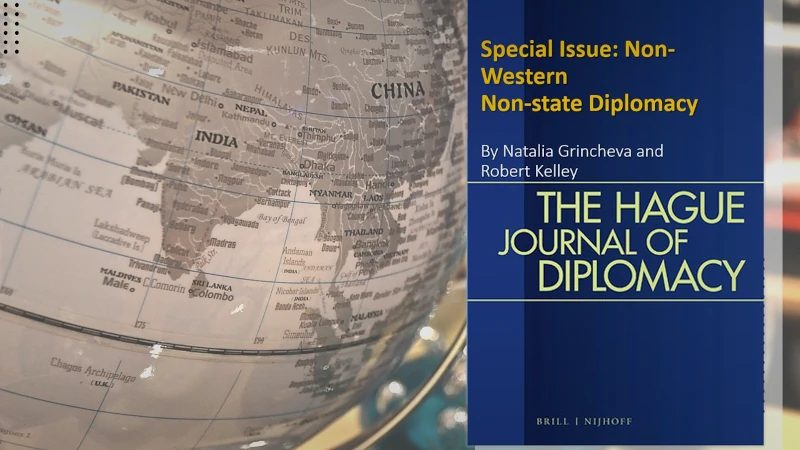
Special Issue: Non-Western Non-state Diplomacy

Non-Western Non-state Diplomacy - The Hague Journal of Diplomacy

Grincheva, N., & Kelley, R. (Eds.) (2019). Non-Western Non-state Diplomacy. Special Issue of The Hague Journal of Diplomacy, 14(3). Brill | Nijhoff.
Online ISSN: 1871-191X, Print ISSN: 1871-1901,


In Non-Western Non-state Diplomacy, published as a guest-edited special issue of The Hague Journal of Diplomacy, Natalia Grincheva and Robert Kelley present a critical intervention in diplomatic studies. The issue challenges two dominant academic biases: the tendency to evaluate diplomatic practices worldwide through a Western-centric lens and the assumption that non-state diplomatic agency requires Western-style democratic structures to achieve legitimacy.

The volume frameworks a “post-globalist” approach that decentralizes traditional, state-centric models to examine how non-state actors—ranging from domestic NGOs and diaspora groups to private cultural organizations—exercise international influence in non-Western contexts like China, Russia, and Turkey. The volume conceptualizes two primary operational modes: cooperative diplomacy, where hybrid or autonomous non-state structures navigate and thrive alongside authoritarian regimes; and adversarial diplomacy, where non-state actors actively challenge state narratives by engaging directly with foreign publics. By unpacking how unique socio-political histories, global information flows, and emerging technologies shape these non-Western actors, Grincheva and Kelley establish a more pluralistic, epistemologically inclusive framework for understanding global governance and contemporary international relations.

Forthcoming Book: Digital Soft Power of Heritage Media

Grincheva, N. (Forthcoming) Digital Soft Power of Heritage Media. Cambridge: Cambridge University Press.


Digital Soft Power of Heritage Media will critically interrogate how the global media strategies of heritage institutions are being fundamentally reshaped, advanced, and challenged in the age of artificial intelligence. Moving beyond traditional paradigms of platformization, this book re-evaluates the three foundational dimensions of digital soft power—content, audiences, and narratives—through a critical media lens.

It examines how digitized heritage content is modified by generative multi-modal models, how online audiences evolve from passive digital consumers into algorithmically mediated co-creators, and how curated heritage narratives are continuously contested across automated, post-truth digital ecosystems. Drawing on empirical computational insights from the Data to Power mapping platform and recent frameworks in smart cultural data intelligence, the book deconstructs the political technologies and algorithmic governance shaping contemporary heritage diplomacy. By analyzing the tensions between automated content generation and narrative authenticity, the book exposes the risks of digital drain and algorithmic censorship alongside new possibilities for participatory heritage. Ultimately, the book offers a nuanced theoretical and empirical critique of how heritage media can ethically navigate generative AI to exercise soft power in an increasingly fragmented geopolitical landscape.

Forthcoming Edited Collection: Mapping The Korean Wave

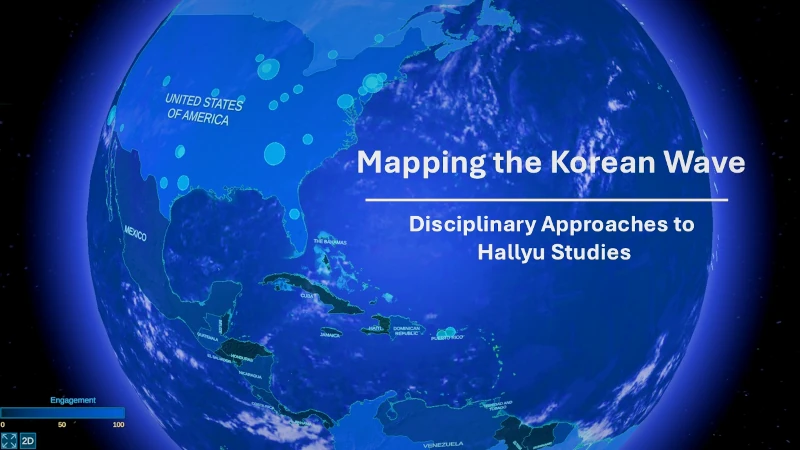
Mapping the Korean Wave: Disciplinary Approaches to Hallyu Studies

Grincheva, N. and Williams, P. (Eds.) (Forthcoming) Mapping the Korean Wave: Disciplinary Approaches to Hallyu Studies. London: Routledge.


Mapping the Korean Wave: Disciplinary Approaches to Hallyu Studies provides a timely, transformative intervention in global media scholarship by examining how diverse epistemic systems shape our understanding of South Korea’s cultural rise. While existing literature often analyzes the Korean Wave through isolated thematic or regional lenses, this volume adopts an explicit multi-disciplinary and multi-methodological framework.

It convenes perspectives across the humanities and social sciences—from econometrics and political science to ethnography and computational data analysis—to interrogate Hallyu’s multi-scalar impact across macro geopolitical strategies, meso-level fan practices, and micro-level identity formation. Critically, the volume compels contributors to reflect on the distinct theoretical affordances, methodological tools, and implicit biases inherent in their respective fields. By showcasing innovative frameworks, including mixed methods and computational data storytelling, the collection addresses structural gaps and historical myopia in current scholarship. Rather than treating Hallyu merely as a research object, the volume foregrounds interpretive paradigms to model disciplinary synthesis and epistemological self-awareness. Aligned with Routledge's “Internationalizing Media Studies” series, this volume marks the academic maturation of Hallyu Studies, offering a reflexive, globally engaged roadmap for decoding transnational cultural flows in the 21st-century mediascape.