Book Chapters

Global Geopolitics, Heritage Diplomacy & Transnational Cultural Flows

Forthcoming Chapters

  1. Grincheva, N. (Forthcoming) Stepping Inside the Story: Embodiment, Emotion & Encounter in Yu's VR Art. In Calvert, J., Dooley, K., Munro, K. and Stubbs, B. (eds.) Expanded Storytelling Across Media: Creative Practices and Critical Approaches. Routledge.

    In Stepping Inside the Story, Dr. Natalia Grincheva and XR visual artist Benedict Yu investigate the transformative potential of Extended Reality (XR) in contemporary storytelling, proposing a paradigm shift from linear narratives to co-constructed, embodied interaction. Structured as a collaborative dialogue, the chapter articulates Yu’s concept of “visceral reality”—a kinesthetic, affective, and participatory mode of storytelling where user presence drives narrative discovery. Drawing on Yu’s 2025 exhibitions, In Reverie in Singapore and Candlelight in the Dark in Seoul, the authors unpack a tripartite theoretical framework. “VR Embodiment” reveals how physical movements and proprioception turn visitors into active co-authors. “VR Emotion” demonstrates how spatial audio and luminous textures architect self-paced affective arcs without compromising user agency. Finally, “VR Encounter” shows how abstracting human forms into light-emitting silhouettes creates an unfinalized, non-appropriative space for shared grief, establishing that XR narratives are ultimately authored through empathetic, embodied presence.

Book Chapters

  1. Grincheva, N. (2025). Genealogy of museum diplomacy: from gift to franchise diplomacies. In Vickery, J., Macdonald, S. and Cull, N. (eds.) Understanding Cultural Diplomacy and International Cultural Relations. Edward Elgar Publishing, pp. 138–147.
    Part of ISBN 9781035312849, https://doi.org/10.4337/9781035312856.00027

    This chapter traces the evolution of museum diplomacy from the Renaissance to the present day, examining how museums have transformed from private collections of curiosities to powerful instruments of cultural diplomacy. Through historical analysis, the study identifies three key phases: the birth of museums through object diplomacy and gift exchange; their institutionalization as representations of national power and identity; and their contemporary expansion into global franchise operations. The research demonstrates how museums have evolved from colonial-era repositories of looted artifacts to modern cultural institutions that engage in complex diplomatic relations through exhibitions, loans and international partnerships. The chapter highlights how economic pressures and globalization have pushed museums to adopt new business models, including corporate partnerships and franchise operations, leading to “post-conventional diplomacy” that often operates independently of traditional state support. This transformation reflects broader changes in cultural diplomacy and international relations in the 21st century.

  2. Grincheva, N. (2025). Smart Heritage in City Branding. In Sevin, E., Björner, E. and Oliveira, E. (eds.) Elgar Encyclopedia of City and Place Branding. Edward Elgar Publishing, pp. 395–399.
    Part of ISBN 9781035319633, https://doi.org/10.4337/9781035319640.00098

    This entry defines smart heritage as an innovative heritage management model in urban development, converging heritage preservation with the dynamic capabilities of smart technologies, that could encompass smart devices and interactive digital systems. It argues that smart heritage facilitates unique and engaging urban experiences enhancing city branding, while exploring two fundamental components of urban brand management, creating a brand identity delivering a brand experience, in relation to the role and place of smart heritage.

  3. Grincheva, N. (2025). From innovative methodologies to creative mythologies. In Hara, N. and Fichman, P. (eds.) Social Informatics. Routledge.
    Part of ISBN 9781032678542, https://doi.org/10.4324/9781032678542-6

    Drawing on a social informatics approach, this chapter explores data mapping methodologies applied to public and cultural diplomacy evaluation studies to identify their strengths and expose their limitations and weaknesses. Specifically, this chapter shares results of the critical digital practice research project “GLAM and Digital Soft Power in the Post-pandemic World,” completed in 2022 in collaboration with the Digital Diplomacy Research Centre at the University of Oxford to explore computation methods for the purposes of mapping and assessing soft power of cultural heritage institutions on a global scale. It identifies and explores boundaries between innovative data-driven methodologies and creative data “mythologies,” which emerge as a result of “contextual” limitations that current big data aggregation and analysis tools possess. This chapter shares advancements in soft power measurement that aim to identify avenues for further developments, signaling current boundaries and flagging limitations in data-driven computational methodologies. While on the one hand, this chapter focuses on the insights that data analytics could bring to better understand soft power reach, appeal, and engagement across countries, it also identifies data mythologies that arise from biases associated with data access and data contexts.

  4. Grincheva, N. (2025). Digital soft power. In Aday, S. (ed.) Handbook on Public Diplomacy. Edward Elgar Publishing.
    Part of ISBN 9781803926551, https://dx.doi.org/10.4337/9781803926568.00041

    This chapter reflects on the 2022 research project, "GLAM and Digital Soft Power in the Post-pandemic World," exploring computational methods to map and assess the soft power of cultural heritage institutions globally. It contributes to academic scholarship on soft power by taking several key steps. First, it situates the analysis within the context of accelerating digitalization and datafication in global information flows, impacting cross-border audiences. Second, it discusses the capabilities of the Data to Power mapping solution, aggregating and leveraging large volumes of data, both institutional and open access, to geo-visualize digital soft power across multiple layers. The chapter focuses on digital soft power within specific actors and resources associated with GLAM institutions, identifying variables affecting their ability to generate soft power. Lastly, it advances an understanding of the digital soft power target response, offering ways for more nuanced profiling of digital audiences.

  5. Grincheva, N. (2024). Museums, Smart Cities and Big Data: How to Transform Data Excess into Data Intelligence? In Richardson, I. and Hendry, N. (eds) Data Excess in Digital Media Research. Emerald Publishing.
    Part of ISBN 9781804559451, https://dx.doi.org/10.1108/978-1-80455-944-420241009

    This chapter discusses the challenges and opportunities of integrating big data generated by contemporary museums into data ecology and data fabrics of smart cities. First, it exposes that smart cities could enhance their global reputation, visibility and image by building on closer collaborations with museums. Second, it demonstrates that museums in the 21st century have transformed into hyper-connected cultural hubs, spreading their reach and impact beyond their immediate urban locations. Finally, this chapter discusses creative approaches to data-curation mechanisms that stress the role of museums and cultural heritage sites in supplying data for a more strategic and proactive smart city co-design and management. Specifically, this chapter offers a three-dimensional framework for integrating heritage data in the design of smart city data ecosystems, which includes such components as Data Resources, Data Republics and Data Impacts. Data Resources stresses museum collections' data and meta-data as a strategic resource to empower creative public data-curation practices to tell meaningful stories about the city and enhance place-making. Data Republics focuses on big data generated by visitors online or on-site as a foundation for evidence-based urban research, design and management, empowering more sustainable, safe and enjoyable tourism. Data Impacts details data-driven methodologies that museums could employ to measure public sentiment and opinion to offer new human-centred indicators to understand the performance of smart cities. This chapter shares a conceptual framework for repurposing museum data within a smart city data ecology to translate the current data excess into data intelligence.

  6. Grincheva, N. (2024). Museum Funding: Moving up the Creative Economy Scale. In Jung, Y., Shane, R. and Wells, J. (eds) Financial Management in Museums. Routledge.
    Part of ISBN 9781003308003, http://dx.doi.org/10.4324/9781003308003-3

    Financial Management in Museums considers sustainable and innovative solutions to current museum financial challenges by analyzing the many changes and pressures affecting the museum field. Presenting diverse perspectives from a range of authors around the world, the book shares and compares different funding models and methods of museum financial management. Arguing that museums need to be more effective in obtaining and managing financial resources, the volume also demonstrates how innovative and sustainable financial management strategies and structures can allow museums to respond to societal pressures and issues in a more effective way. It also demonstrates that museums must allocate resources responsibly to fulfill their goals of justice, equity, inclusion, and accessibility. The theoretical and practical contributions within the volume cover a comprehensive range of topics, including foundational concepts, revenue, expenses, budgeting, financial leadership, strategic planning, mission-based investment strategies and alternative revenue strategies. Financial Management in Museums focuses on the unique financial needs and structures of museums, while also considering important lessons from adjacent sectors. It will be essential reading for students and academics engaged in the study of museums, arts and cultural management and business. The book will also be useful to museum professionals working around the world.

  7. Grincheva, N. (2023). Digital cultural diplomacy: from content providers to opinion makers. In Bjola, C. and Manor, I. (eds) The Oxford Handbook of Digital Diplomacy (pp. 194–211). Oxford University Press.
    Part of ISBN 9780192859198, http://dx.doi.org/10.1093/oxfordhb/9780192859198.013.11

    The chapter identifies and describes major transformations of cultural diplomacy in the conditions of increasing digitalisation and platformization to propose a new typology of cultural diplomacy actors. Focusing on the roles they play in the global digital space and the power they can accumulate to exert impact, the chapter explores cultural diplomacy actors from the perspective of their involvement in the processes of digital cross-cultural communications. It argues that traditional government actors of cultural diplomacy in the digital realm increasingly become more dependent on cultural institutions and communities who serve as key cultural content providers. Furthermore, their activities in the digital domain are shaped by interfaces, digital capabilities, and algorithms of dominant communication platforms, designed by transnational corporations as main digital infrastructure builders. Finally, they operate in a very dynamic communication space populated by various opinion makers, including individual influencers, who accumulate a significant diplomatic power to shape global discourses. Providing provocative illustrations to describe major functions of each actor, the chapter exposes a highly saturated, heterogeneous, and complex nature of global cross-cultural communications that requires a more nuanced actors' typology to help its deeper analysis.

  8. Grincheva, N. (2023). "Contact zones" of heritage diplomacy: transformations of museums in the (post)pandemic reality. In Lähdesmäki, T. and Čeginskas, V. (eds) Heritage Diplomacy: Discourses, Imaginaries and Practices of Heritage and Power (pp. 76-93). Routledge.
    Part of ISBN 9781032535029

    Tracing transformations in the museum agency under the pressure of the pandemic crisis in 2020, the article conceptualizes museums as dynamic "contact zones" of heritage diplomacy. It explores two foundational components of a contact zone, such as building a social space for a cross-cultural encounter, negotiation and debate as well as offering a platform to address transnational concerns on the heritage decolonization agenda. Drawing on desk research, document analysis and semi-structured interviews with museum professionals, it analyses the case studies of the livestreaming bilateral museum diplomacy and metaverse live heritage pandemic diplomacy, followed by a discussion on the processes of museums decolonization that started to unfold in response to the 2020 Black Lives Matter movement. The research argues that the impact of the digitalization pressures did not only affect the ways, forms, and structures of cross-cultural communications in museums, but also moved them a bit forward in their decolonization processes.

  9. Fensham, R., Grincheva, N. and Sumner, T. (2023). More Than a Lab: Infra-Structuring the Humanities in the Digital Studio. In Pawlicka-Deger, U. and Thomson, C. (eds) Digital Humanities and Laboratories (pp. 89-104). Routledge.
    Part of ISBN 9781003185932

    This chapter articulates the formation of a responsive epistemic culture of research as “infra-structuring”. It identifies three interrelated components of humanities research practice that (re)define infrastructure in the context of the Digital Studio at the University of Melbourne. This digital laboratory produced an epistemology that became manifest through the critical assemblage of resources, architecturally inflected interdisciplinary research, and a connected intelligence approach that was able to empower sustainable cross-institutional knowledge creation. The chapter also examines a novel case study, its experimentation, and alliances, and in so doing, advocates for the agential and ethical demands of research in the 21st-century humanities.

  10. Grincheva, N. (2023). Cultural Diplomacy. In Gilboa, E. (ed.) A Research Agenda for Public Diplomacy (pp. 205–218). Edward Elgar Publishing.
    Part of ISBN 9781802207316, https://doi.org/10.4337/9781802207323.00022

    Exploring major focus and key topics of cultural diplomacy current literature, the chapter outlines the future research agenda of this growing academic discipline. First, the chapter explores alternative geographies and agencies of diplomacies that have not been extensively covered in scholarship. It proposes new areas for focused research on macro and micro geographical levels which pertain to diplomacies going beyond states-driven bilateral relationships. Second, understanding cultural diplomacy as a dynamic practice that brings together artists, policy makers, governments and civil society, the chapter conceptualizes transformations caused by the emergence of new technologies, artistic expressions, cultural trends, and arts practices. It demonstrates that while cultural diplomacy is dynamically changing to cope with the pace of all these new developments, there is a growing need to explore more closely new hybrid models and digitally mediated environments of international cultural communications which increasingly engage non-human actors.

  11. Grincheva, N. (2022). The future of cultural diplomacy: From digital to algorithmic. In Jung, Y., Vakharia, N. and Vecco, M. (eds) The Oxford Handbook of Arts and Cultural Management (pp. C11.S1-C11.S6). Oxford University Press.
    Part of ISBN 9780197621615, https://doi.org/10.1093/oxfordhb/9780197621615.013.11

    This chapter conceptualizes changes in arts management practices from the perspective of cultural diplomacy, which has experienced significant transformations in the age of increasing digitalization. It explores and illustrates how new media technologies and data practices recalibrate the context in which cultural diplomacy operates by reshaping the medium of artistic communication, empowering new actors and equipping them with new tools to establish, deliver, maintain, and assess their global communication campaigns. The chapter identifies and describes three key aspects of cultural diplomacy transformations: virtualization, algorithmization, and datafication. Exploring the current cultural diplomacy activities reflected through institutional and government reports and press releases, the chapter offers a bird's-eye view of global arts practices to critically reflect on the new dimension of cultural diplomacy.

  12. Grincheva, N. (2022). Making museum global impacts visible: Advancing digital public humanities from data aggregation to data intelligence. In Schwan, A. and Thomson, T. (eds) The Palgrave Handbook of Digital and Public Humanities (pp. 397–419). Palgrave Macmillan, Cham.
    Part of ISBN 9783031118852, https://doi.org/10.1007/978-3-031-11886-9_21

    The chapter pursues two goals: first, it aims to situate big data analysis within the growing field of digital humanities; second, it employs an empirical exploration of the project "Deep Mapping" to discuss and demonstrate challenges and opportunities of the recent advancements in the big data digital humanities, specifically in the field of cultural geo-visualization. It identifies and examines three foundational levels of digital humanities research practices which include (1) Data Aggregation, (2) Data Visualization, and (3) Data Intelligence. Each of these levels forms a progression of the digital public humanities research from the mere capture of cultural data to its strategic employment for generating new insights to forecast development of a specific digital phenomenon, object, or process. Drawing on this framework, the chapter conceptualizes big data curation within digital humanities as an area of research and practice that entails a strong engagement with the wider public beyond academia.

  13. Grincheva, N. (2020). Is there a Place for a Crowdsourcing in Multilateral Diplomacy? Searching for a New Museum Definition: ICOM versus the world of museum professional. In Bjola, C. and Zaiotti, R. (eds) Digital Diplomacy and International Organisations (pp. 74–98). Routledge.
    Part of ISBN 9781003032724, https://doi.org/10.4324/9781003032724-5

    This chapter explores the practice of crowdsourcing in global governance as a tool of multilateral diplomacy to interrogate its exact role and place in the decision-making processes. It investigates the case of the online cultural diplomacy of the International Commission of Museums (ICOM), focusing on the 2019 crowdsourcing campaign delivered by the ICOM's Standing Committee for Museum Definition, which aimed to collect public contributions to re-define the museum agency in the 21st century. The chapter draws on media discourse analysis of the public debates concerning the new definition and applies content analysis of the 268 definitions submitted by the public to the ICOM's official online platform. It also features interview insights from the MDPP Committee Chair. Based on key findings, the chapter argues that in the context of ICOM, multilateralism 2.0 remains a desirable vision rather than a reality.

  14. Grincheva, N. (2020). Museums as Actors of City Diplomacy: From "Hard" Assets to "Soft" Power. In Amiri, S. and Sevin, E. (eds) City Diplomacy. Palgrave Macmillan Series in Global Public Diplomacy (pp. 111-136). Palgrave Macmillan, Cham.
    Part of ISBN 9783030456146, https://doi.org/10.1007/978-3-030-45615-3_6

    Historically, museums have earned their dedicated role as important agents of cultural diplomacy. In the age of increasing urbanization, museums have become important center of urban soft power and actors of city diplomacy. This chapter argues that museums are vital actors of city diplomacy, because of a high cultural and economic value of their "hard" or tangible resources and "soft" power of their social activities that engage global audiences and facilitate international cultural relations. This chapter discusses this framework of museum diplomacy resources and outputs in two main sections. The first section focuses on "hard" assets of museums such as collections and facilities. It explains why and how the cultural infrastructure offered by museums play an important role in city diplomacy, especially in place making and city branding. The second section explores soft power generated by museums through their social activities and programming that help activate cultural resources and transform them into diplomatic outputs.

  15. Grincheva, N. (2020). Deep Mapping: Creating a Dynamic Web Application Museum "Soft Power" Map. In Jacobs, H. and Fischer, B. (eds) Visualizing Objects, Places, and Spaces: A Digital Project Handbook. The MIT Press Online.
    https://doi.org/10.21428/51bee781.3856e5cb

    The project employs Geographical Information Technologies to develop a pilot version of the digital mapping system "Museum Soft Power Map". This digital system offers a new computation research method to explore contemporary museums and geography of their influence. It geo-visualises museum "soft power", defined as an institutional ability to mobilise global public, generate economic activity, and attract international investments.

  16. Grincheva, N. (2018). Researching Online Museums: Digital Methods to Study Virtual Visitors. In levenberg, l., Neilson, T. and Rheams, D. (eds) Research Methods for the Digital Humanities (pp. 103–128). Palgrave Macmillan, Cham.
    Part of ISBN 9783319967127, https://doi.org/10.1007/978-3-319-96713-4_7

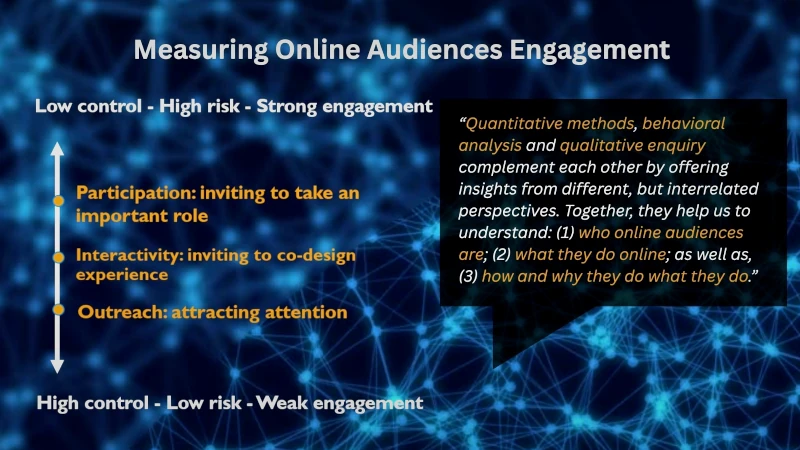
    Digital ethnography can be used to study online audiences and virtual communities built around museum content. Virtual museum visitors can participate in online museum spaces, including interactive online galleries, virtual three-dimensional museum simulators, or museum profiles on social network sites or blogs. These online environments can include recording tools, to trace all of the activities of the users and to display all of the visible records. This chapter discusses challenges, ethical implications, and online research opportunities of the digital ethnographic methodology employed to study online museum audiences. It illustrates the method through empirical studies of online communities at internationally recognized museums. Digital ethnographic research conducted in online museum communities can inform Digital Humanities and incorporate perspectives from visitor studies.

  17. Grincheva, N. (2018). Global PR that works: The Case of the State Hermitage Museum, Saint Petersburg, Russia. In Stevenson, D. (ed.) Managing Organisational Success in the Arts (pp. 127-146). Routledge.
    Part of ISBN 9781315185729, https://doi.org/10.4324/9781315185729-9

    This chapter offers a case study of the Hermitage International Network of Foundations analysed through the lens of Bourdieu's theory on bonding, bridging and linking social capital. It illustrates how nurturing long-term social connections at an institutional and personal levels helps the Hermitage to generate economic revenue in support of its development programs. It is important to stress that the success of the Hermitage's global public relations (PR) should first of all be attributed to the institutional focus on establishing strong relationships with different types of constituencies, rather than merely seeking new sources of revenue. The chapter discusses the conceptual framework and environmental context, three key sections identify, explore and explain various types of constituency of the Hermitage's international PR. Organizational PR is usually based on communication with internal and external publics in order to achieve positive long-term relationships that can help to reach organizational goals and satisfy societal expectations.

  18. Grincheva, N. (2017). Museum Ethnography in the Digital Age: Ethical Considerations. In Zimmer, M. and Kinder-Kurlandan, K. (eds) Internet Research Ethics for the Social Age (pp. 187-194). Peter Lang.
    Part of ISBN 9781433142673

    As a digital museum ethnographer, I would like to devote this chapter to sharing my personal experience in addressing ethical considerations while conducting research on museum visitors' behavior in online spaces. My research looks at online museums as important sites of cross-cultural communication. These sites project powerful political and cultural messages across borders and engage not only local but predominantly international audiences. Captivated by the diversity of online museum programs that connect people across the globe, opening up virtual spaces for cross-cultural learning, and immersing online visitors into educational experiences, I traveled the world to conduct a number of case studies. I researched digital spaces of large international museums in Canada, the United States, the United Kingdom, Australia, and Singapore. My ethnographic research revealed that museum online communities as social interactive worlds can be powerful tools of cultural representation or mis-representation, sites of memory and identity construction, and building citizenry or political battlegrounds of resistance and social riots. Online museums can build unique "bridges" among communities for improving intercultural competence and tolerance or, in contrast, can invoke religious and cultural wars. These insights and findings were possible due to immersive ethnographic research within different digital museum spaces. I explored various online museum communities and collected and analyzed a large amount of textual and visual data demonstrating various behaviors of online "museum goers".

  19. Grincheva, N. (2017). Sustainable Fundraising in the 21st Century: Behind the Scenes of the Global Guggenheim Success. In Jung, Y. and Love, N. (eds) Systems Thinking in Museums: Theory and Practice (pp. 181-190). Rowman & Littlefield.
    Part of ISBN 9781442279230

    While much has been written already about the Bilbao effect in terms of economic impacts,11 there is no dedicated research yet that would explain why the Guggenheim Bilbao phenomenon came into existence and what external forces and consequences directly contributed to its development. Moreover, it is even more fascinating to find out how this successful economic experiment influenced the Guggenheim's further development. Did the Bilbao effect have an essential impact on the Guggenheim's global growth? If so, how exactly did this phenomenon aid the museum to pursue its mission on the global scale? Applying a systems thinking approach, this chapter looks at the Guggenheim Foundation as an open system that continuously interacts with the external environment and constantly "adjusts to a new equilibrium if a change occurs in the way the parts are arranged" within a larger context.12 Understanding global economic reality as external environment in which museums operate, the chapter looks at the Guggenheim as a complex system within a larger economic reality, going far beyond the US context. It explores how stepping outside the local borders by developing a franchising network across different countries expanded the Guggenheim's opportunities and brought fundraising practices to a new global level. The chapter analyses the Guggenheim example to demonstrate that staying attuned to global economic changes, or in other words, adequately adjusting the museum's system to changes in a larger environment, has a profound impact upon institutional development. The Guggenheim case illustrates how a strategic reconfiguration of fundraising approaches in the twenty-first century can help large and internationally known museums to tap into resources available for them in the global context.

  20. Grincheva, N. (2016). Museum dimension of American "Soft Power": Genealogy of cultural diplomacy institutions. In Chambers, M. (ed.) "Hearts and Minds": US Cultural Management in Foreign Relations in the 21st Century (pp. 125-164). Peter Lang.
    Part of ISBN 9783631667309

    Through a genealogical analysis of such a phenomenon as an American museum this chapter traces the core philosophical ideals of the American democratic tradition and a national belief in the institutional destiny of the U.S. museums. Drawing on the genealogy, as a Foucauldian method (1984) to trace "origins" and to question them on deeper levels, my work looks at the origins of the foundational principles that made American museums powerful projectors of philosophical ideals of American democracy, exceptionalism, and cosmopolitanism.

  21. Grincheva, N. (2015). Singapore Memory Project: Producing Public Memory Through Social Media. In Gordon, E. and Mihailidis, P. (eds) Civic Media Project. The MIT Press Online.

    Drawing on the Habermas theory of public sphere and communicative action, the paper looks at the Singapore Memory Project as an online social space representing two different communicative rationales, describing the social dimension of the online mass communication processes: strategic "colonization" and public "emancipation". On the one hand, the "democratic" participative nature of the social media platform enacts the "communicative action of the life world" (emancipation), which contains ethical rationality, enabling participation of various social and cultural groups in "uncontrolled" media representation. In this regard, the social media space of the Singapore Memory Project can be understood as a cultural public sphere, where representatives of various cultural communities and traditions can share their identity, contest their cultural voice, and get an access to the media tools for cultural self-representation.

  22. Grincheva, N. (2012). Canada's Got Treasures! Constructing National Identity through Cultural Participation. In Austen, S., Bishop, Z., Deventer, K., Lala, R. and Ramos, M. (eds) The Cultural Component of Citizenship. (pp. 79-99). Brussels: European House for Culture.
    Part of ISBN 9789081140461

    Digital diplomacy is widely accepted in Canada and has been extensively utilised through building and sustaining the Canadian Heritage Information Network (CHIN) . The network offers a wide variety of online programs and provides interactive resources such as the Virtual Museum of Canada (VMC) . "Canada's Got Treasures" is an online portal developed by the VMC in cooperation with national heritage institutions including the Canadian Museum of Civilization, the Canadian War Museum, the National Gallery of Canada, and others. Using popular social media networks, such as YouTube and Flickr, the project aims to build an online interactive repository of Canadian national heritage through contributions by national cultural institutions, as well as by ordinary Canadians. Interested individuals are invited to take part in the project by contributing their own personal photos and videos to the online collection of national treasures and thus share their personal understanding of Canadian heritage. This paper argues that the "Canada's Got Treasures" web portal is an interactive communication tool of the CHIN for national identity construction and promotion of the ideas of Canadian collective culture, as well as national citizenship and patriotism. Through a detailed content analysis and rhetorical discourse analysis of this cultural heritage portal, this project seeks to identify and examine social and political mechanisms of national identity construction employed by the VMC.